Omonoia: Beneath the Neon and Concrete
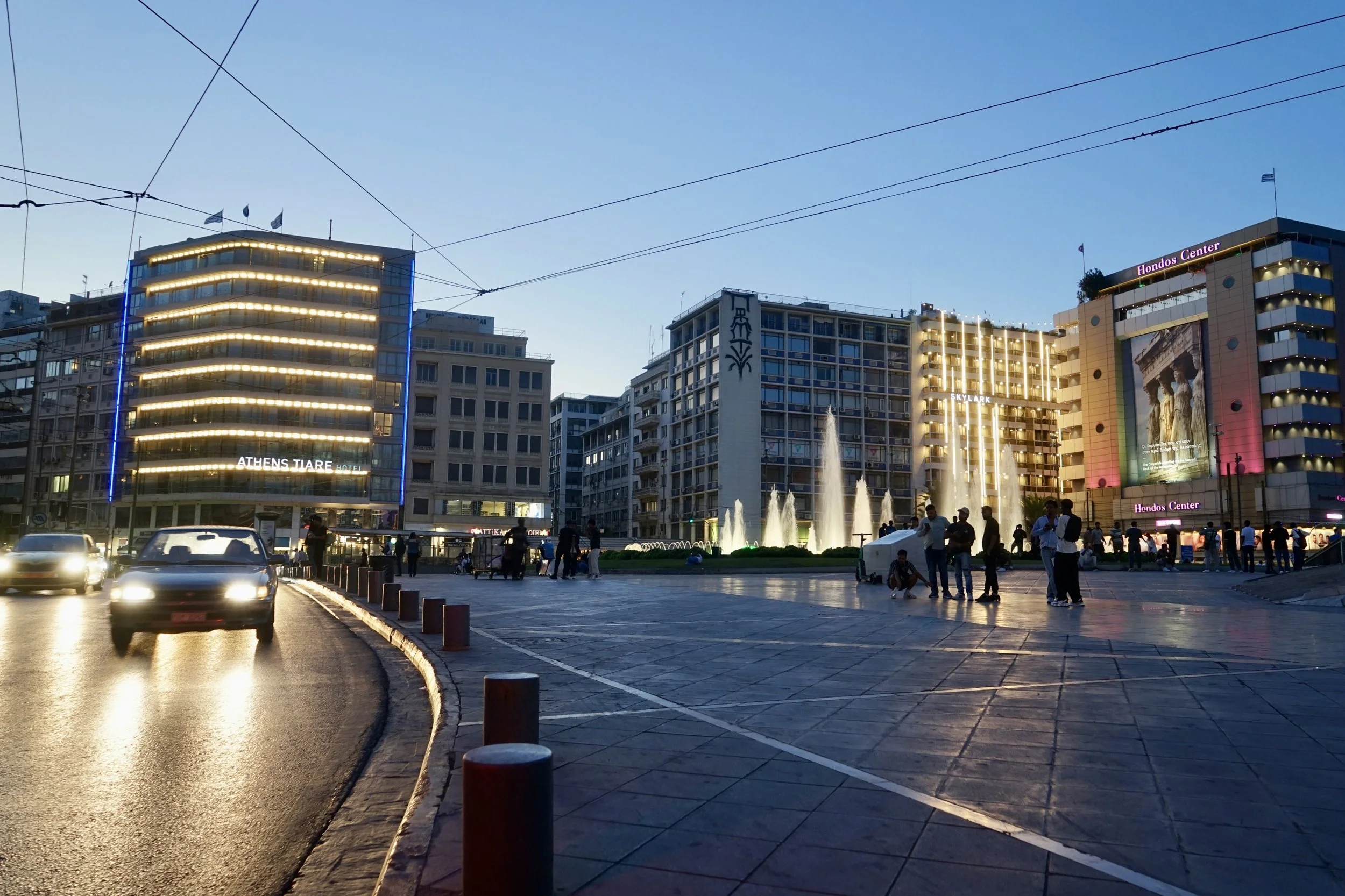
Dusk over Omonoia Square, capturing the quiet shift from day to night. — Photo: Alexander Pinheiro
If you stand in the middle of Omonoia Square (pronounced “Omonia”) long enough, the city starts to reveal its heartbeat. To the casual tourist, Athens is a city of ancient ruins and postcard-perfect views of Plaka. But to anyone who spends real time on the ground, Omonoia is perceived differently. It is where the myth of historic Athens meets the gritty reality of a modern, living metropolis.
It is one of Athens’ oldest and major central squares, originally conceived in the 19th century as an elegant neoclassical urban hub. It was first named Plateia Anaktoron (Palace Square), and later renamed Plateia Othonos (Othonos Square), after King Otto. Following the king’s deposition in 1862, It was renamed Omonoia, meaning “concord” or “harmony.” The square has undergone numerous transformations over the decades, from a romantic palm-tree promenade to a concrete traffic junction. And then from a modern paved basin to most recently a massive circular fountain illuminated beneath the neon signs and hotel facades surrounding it. Yet Omonoia’s true character has always been defined by its people, not its architecture.
On any given afternoon, Omonoia acts as a historic and kinetic crossroads of human lives that rarely intersect anywhere else. Elderly locals sit on nearby benches, observing the tide of commuters. Street vendors sell, amongst other things, sesame-crusted koulouri fresh from wooden trays. Immigrant business owners have transformed the surrounding streets and alleyways into a rich tapestry of international enterprise. The streets surrounding Omonia are lined with a dense mix of small shops, cafés, restaurants, hotels, and other businesses serving communities from across Greece and beyond. Signs and storefronts reflect the area’s multicultural character, alongside Greek businesses. The neon signs from towering local and international hotels cast a bright glow over the streets that have seen their fair share of economic turbulence and quiet resilience.
From a storyteller’s perspective, the square presents a masterclass in natural visual contrast. The sleek, perfectly symmetrical spray of the central fountain sits directly against the chaotic, asymmetrical flow of traffic circling it. Deep blues of the evening sky settles over the square, as the city’s artificial lights begin to take over. There is a rhythm here that doesn’t exist around the Parthenon. Omonoia doesn’t pose for photographs; it moves, trades, hustles, and survives. Omonoia is restless.
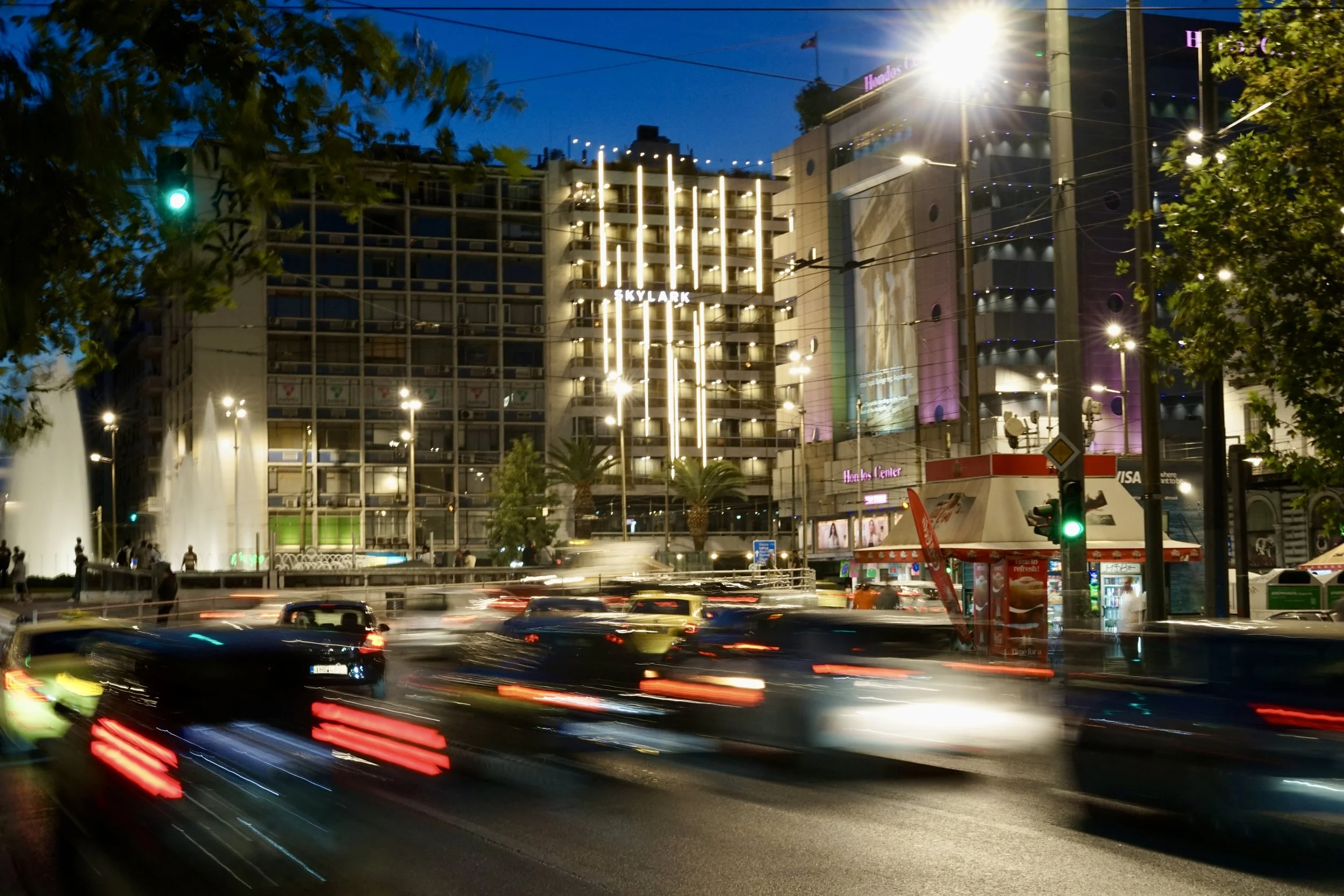
Omonoia Square in the late evening, a kinetic blur of traffic, light, color and movement. — Photo: Alexander Pinheiro
When night falls over Athens, Omonoia Square undergoes a quiet, dramatic transformation. The chaotic rush of afternoon and evening commuters fades, replaced by the low hum of street neon and the rhythmic splash of the central fountain against the dark pavement. If the day belongs to traffic and trade, the night belongs to the square’s quiet observers.
Urban squares are often measured by their commercial activity during the day, but their true character is mostly revealed after dark. Groups of friends gather near the perimeter of the fountain, using the bright public light as a welcoming island in the middle of a dense city. Late-night kiosk vendors and taxi drivers waiting in long lines form part of a night-shift community that keeps the square awake until dawn. A mix of weathered 20th-century facades and newly illuminated hotel buildings creates a cinematic backdrop that feels almost like a film set. Nighttime in Omonoia strips away the city’s hurry, revealing its true sense and history.
For a visual storyteller, Omonoia at night offers an entirely different color palette and mood from the daytime heat. Water spray from the fountain catches the harsh red and white glare of streetlights, creating long reflective streaks across the wet asphalt. Deep indigo skies contrast sharply with warm, glowing shop windows, while individual figures stand beneath bright street lamps against the sweeping motion of late-night traffic passing through the circle. Unlike some of the more polished, tourist-oriented parts of the city, Omonoia hits differently. It doesn’t hide behind a tourist facade. Instead, it feels authentic and intensely alive.
Though it is not one of the legendary wonders of the world, Omonoia reveals something arguably more difficult to capture: the layers of history, social class, architecture, and culture stacked directly on top of one another. It is a living intersection of Athens past and present, and a destination that deserves a place on the radar of anyone who wants to experience the city beyond its postcards.
Written by: Alexander Pinheiro
© 2026 Sane House Media. All rights reserved.
These articles are published for general information, commentary, cultural interest, and entertainment. They may contain personal observations, opinions, interpretations, or information from third-party sources. While every effort is made to ensure accuracy, no article should be considered a definitive or comprehensive account. Some, all, or none of these conditions may apply to this particular article.
