The Invisible Pedestrian: Spending a Week on Foot in Houston
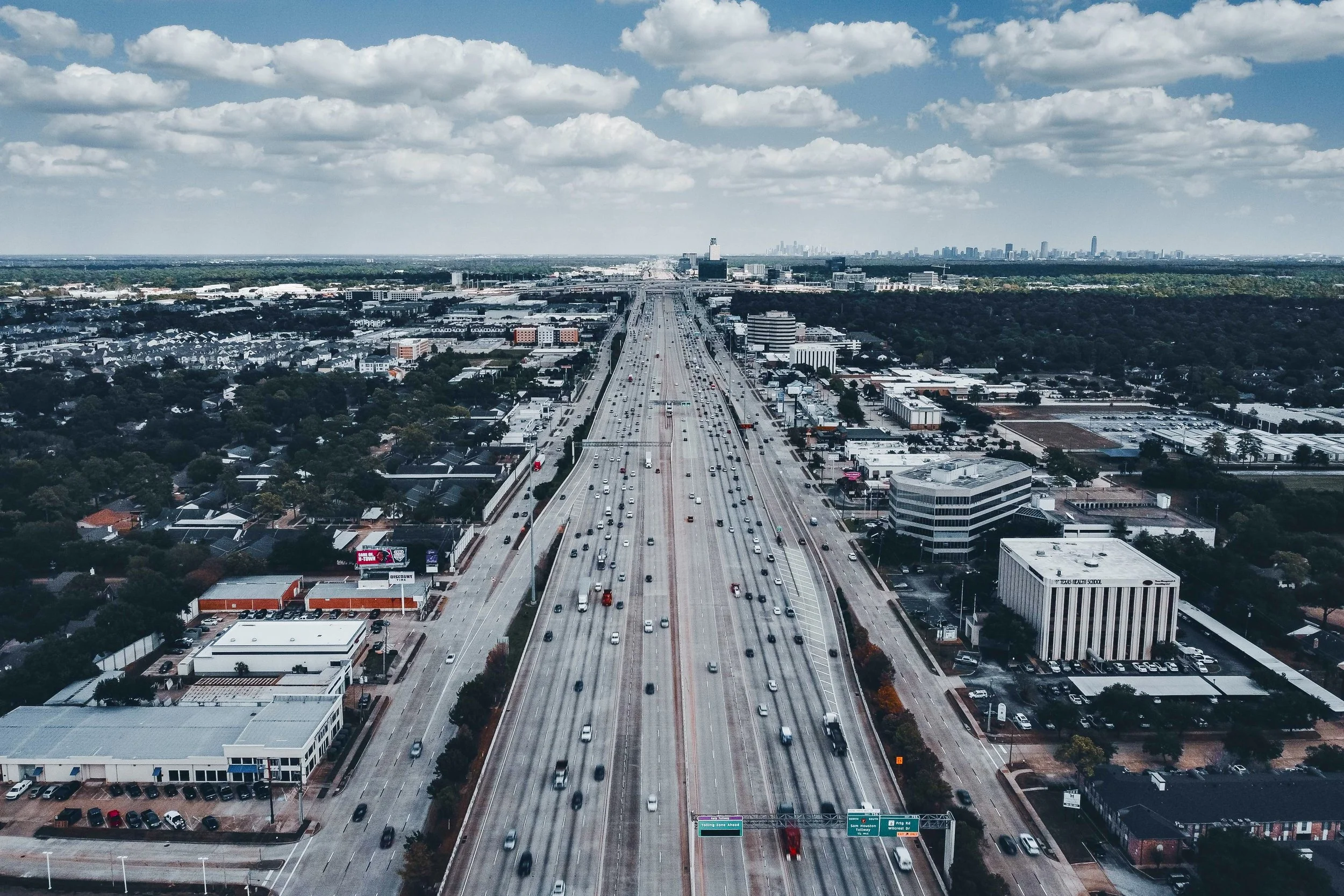
Looking eastbound along the Katy Freeway (I-10) toward downtown Houston, capturing the expansive scale of the western transit corridor. — Photo: Erik Mclean
Coming from the relentless, 24-hour pulse of the New York area, I am used to a world where public transit never sleeps and human foot traffic is the default setting of daily life. In New York, the sidewalk is a shared living room. People walk to buy coffee, walk to catch a train, walk for fitness, walk their dogs or just linger outside on a warm summer night. So, when I arrived in Houston for a week in July with no rental car and a tackle box for fishing, I assumed I would navigate the fourth-largest city in America the way I always do: by bus, rail, and boots on the ground. I quickly realized I was an anomaly. In Houston, to be a pedestrian in a residential neighborhood is to feel like a ghost wandering through a kingdom built almost entirely for automobiles.
I stayed in Sharpstown, a sprawling Houston neighborhood where the scale of everything seemed to work against the idea of simply walking somewhere. Visiting in July meant the daytime sun was a scorching, oppressive wall of heat. Though it rained for two days, I did most of my exploring in the evening when the temperature finally dropped. Even then, taking a stroll through the neighborhood felt surreal. The streets were remarkably quiet. No one was walking past me. Occasionally, I would see a landscaper or a neighbor would jog by. But mostly, it was just cars gliding past. I kept wondering where everyone was going and where they were coming from, because almost no one was out on the pavement.
The lack of pedestrian life also meant that many of the things I would normally expect to find within walking distance simply weren’t there. In the residential pocket where I stayed, there were no neighborhood corner restaurants. If I wanted to eat, I had to cook or order delivery. Even getting basic groceries was an undertaking. The nearest small store was about a quarter of a mile away, while the next proper option was more than a mile into the residential sprawl.
One evening, I stumbled upon a local park within the neighborhood. For a brief moment, the suburbs came to life. Young people were playing basketball, and mothers were out with their kids. But as dusk settled and darkness began to fall, it was as if someone had flipped a switch. Everyone disappeared, some into their cars and others somehow. The park emptied, and the neighborhood returned to its quiet rhythm.
Downtown Houston offered a different picture, but the contrast with New York remained striking. There was certainly a lot more foot traffic, but the overall scale of human activity on the streets still felt closer to an off-peak corner of New York than to the city as a whole. Houston had people everywhere; they simply weren’t necessarily outside.
My original plan to go fishing at Lake Conroe quickly evaporated once I looked at the map. Realizing what it would take to reach the lake by public transit, I quietly packed away the idea. It felt less like a bus trip and more like a survival mission; if I made it out there, I wasn’t entirely sure I’d make it back alive before the public transit options faded into the twilight. Instead, I stayed closer to the city, spending time at Buffalo Bayou Park and Memorial Park, where Houston’s enormous urban green spaces brought outdoor activity back into view. These were some of the places where the city felt most alive on foot, with people running, walking, exercising, dog socializing and simply spending time outside.
Navigating the rest of Houston by bus revealed another side of the city’s transportation culture. The buses surprisingly ran right on time, but at suburban stops I was almost always the sole passenger waiting. Inside, there were plenty of open seats and I never stepped onto a full bus the entire week. Because the buses weren’t rushed or overcrowded, the drivers operated with a subtle courtesy that felt strange to me. The first time I boarded, being a tall guy, I took my time walking down the aisle, scanning for a front-facing, comfortable seat with good legroom. After a moment, I realized the bus hadn’t moved. I glanced at the rear-view mirror, and the driver was patiently waiting for me to sit down before hitting the gas.
I tested this observation over the next few days. Sure enough, whether it was a single rider or a mother boarding with three kids, the drivers consistently waited until everyone was safely seated or just about settled before pulling away. In a city built around speed and high-speed freeways, the buses moved with a surprisingly patient, unhurried rhythm.
Nothing highlighted the difference between New York and Houston more vividly than my night trip to Houston’s Chinatown around 10:30 PM. Expecting the vibrant street life, neon lights, and late-night sidewalk crowds of Manhattan, I stepped out into what looked like a ghost town adorned with Chinese signage. The businesses were open, but the sidewalks were desolate.
A few Chinese men stepped outside a restaurant to smoke before heading right back in, offering the only brief sign of human activity on the pavement. Hungry and looking for something casual rather than a sit-down restaurant, I spotted another guy standing in a parking lot, tucked between two cars. I walked up to him and said, “Finally, one person. Where is everybody?”He told me they were all indoors, eating or doing whatever, before cutting our conversation short to reveal that he was an Uber driver waiting for an order. Before he left, I asked where I could grab a quick taco or burrito. He casually gave me a spot that turned out to be 2.3 miles away. At 10:30 PM on foot, that was an impossible journey, so I gave up and headed back to my accommodation. People weren’t walking around Chinatown. They were driving into the parking lots, stepping out of their vehicles, walking a few yards across the pavement and into an air-conditioned establishment.
During the day, I began noticing that one of the most common sights on the roadside wasn’t pedestrians at all—it was food trucks. A local explained to me that in a city so spread out, office workers with 45-minute lunch breaks can’t afford to waste 20 minutes driving back and forth to a sit-down restaurant. The food trucks bring the kitchen straight to the parking lots outside their offices. Over the course of my week, I genuinely saw more food trucks than I did fellow pedestrians.
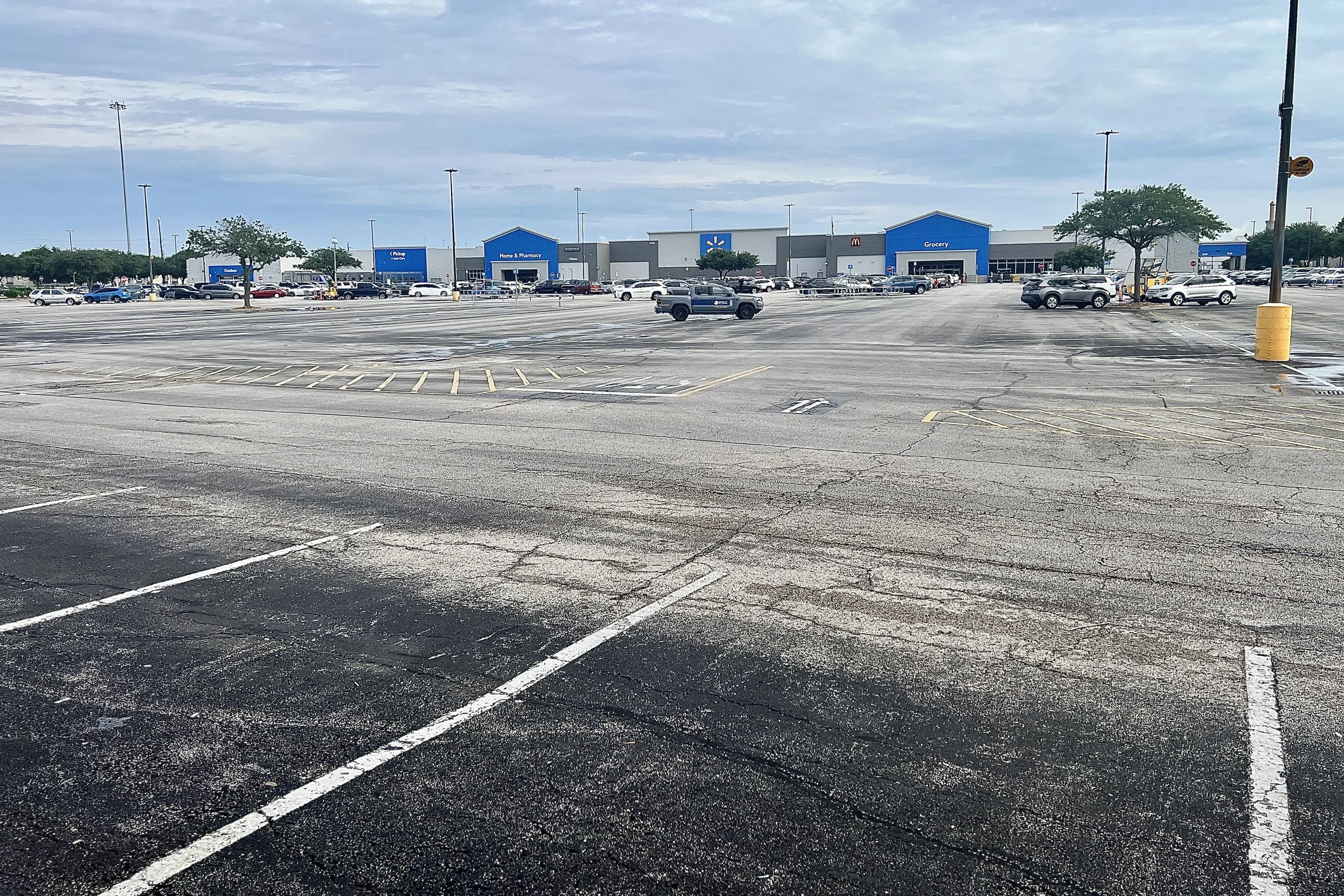
The sprawling parking lot of the Dunvale Road Walmart Supercenter in Houston. — Photo: Alexander Pinheiro
The scale of Houston’s automobile environment became especially apparent during a trip to a local Walmart. When the bus dropped me off, reaching the store entrance felt like a full-blown trek across an ocean of asphalt. The parking lot was indeed massive. Inside, Texas scale took over again! I am a Walmart guy, but believe me, it was the largest, most enormous Walmart I had ever seen in my life, and it was packed with shoppers. The people were there. They were just sheltered indoors.
When I finished shopping, I checked my navigation app to catch my ride back. Luckily, the app directed me to a different bus stop located on the side of the building. It turned out to be my designated stop for the return route, saving me two-thirds of the hike back to where I had originally arrived. Standing alone at that side stop waiting for the bus, the visual was almost too perfect: a store packed with shoppers inside, row of cars in the enormous parking lot outside, and one person waiting on foot.
Back on the quiet residential streets, I quickly noticed another feature that says a great deal about Houston’s everyday life: the driveways. In front of almost every house, I saw two or three personal vehicles parked—typically one or two sedans paired with an SUV, a pickup truck, or a van. Here, a car didn’t feel like a luxury. It felt like a piece of living equipment: an air-conditioned capsule designed to move you from your air-conditioned home to your air-conditioned destination.
And yet, experiencing Houston this way didn’t leave me regretting the decision not to rent a car. Quite the opposite. Being on foot gave me a perspective I might never have noticed from behind the wheel. I saw the quiet residential streets, the nearly empty bus stops, the food trucks serving office workers, the parks filling up in the evening, and the strange contrast of packed buildings surrounded by enormous expanses of asphalt.
Houston is a city of immense land, enormous roads, massive parking lots, warm people, and incredible scale. Experiencing it without a car simply meant seeing some of those things from a different vantage point. Practically from the sidewalk as opposed to through the windshield.
Written by: Alexander Pinheiro
© 2026 Sane House Media
These articles are published for general information, commentary, cultural interest, and entertainment. They may contain personal observations, opinions, interpretations, or information from third-party sources. While every effort is made to ensure accuracy, no article should be considered a definitive or comprehensive account. Some, all, or none of these conditions may apply to this particular article.
