The Seven Wonders of the World: Story Behind the List
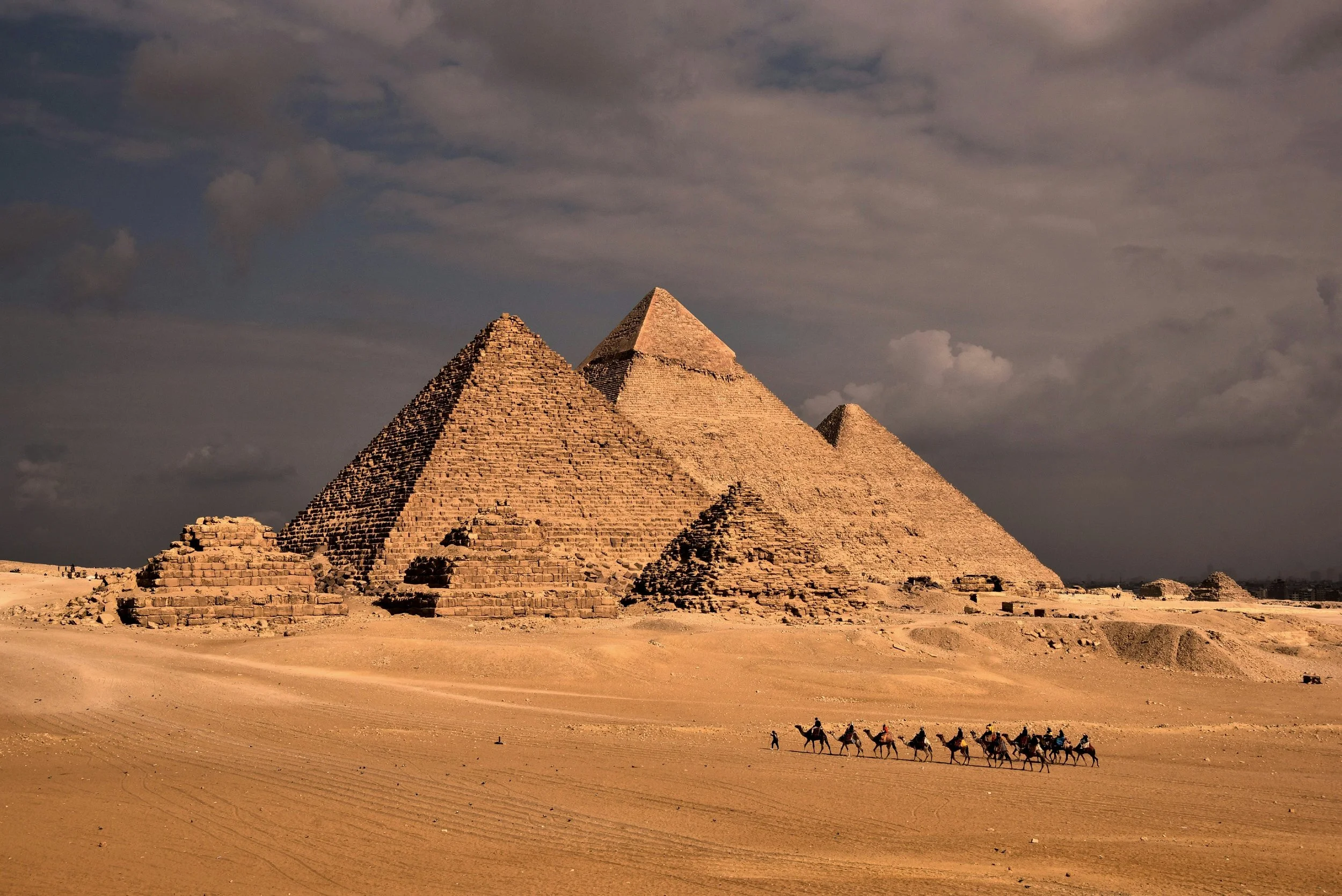
Camel riders passing the Pyramids of Giza beneath a cloud-filled sky. — Photo: Moxin Wang
The most renowned seven wonders of the world are the Great Pyramid of Giza, the Hanging Gardens of Babylon, the Statue of Zeus at Olympia, the Temple of Artemis at Ephesus, the Mausoleum at Halicarnassus, the Colossus of Rhodes, and the Lighthouse of Alexandria. Over the years, this list has been treated like one of humanity’s greatest achievement. Maybe an ancient verdict. Undoubtedly, all of these structures would have been grandiose if they were in existence today, but one can’t help but wonder how these particular wonders made the list. The real story however, is more about an ancient traveler’s guidebook. Yes. A bucket list.
The concept emerged in the Greek-speaking world during the Hellenistic period. A time when Greek culture had spread across much of the eastern Mediterranean and Near East. These sights were referred to as “theamata”, a Greek term meaning “things worth seeing.” The ancient travelers never called them wonders. The list was essentially a collection of places considered significant enough, that a traveler with the opportunity and means might want to see. It also reflected a crucial detail. That is, the travel world and trade routes of Greek writers, omitting monumental structures built elsewhere in Asia and beyond.
When we look at the Seven Wonders today, it is tempting to assign each monument to a modern country. But Egypt, Greece, Iraq, and Turkey weren’t represented on an ancient atlas back then. These monuments belonged to entirely different political and cultural worlds. So the modern map of the world can be misleading. Modern Iraq wasn’t even a country when the list was tabulated. Babylon belonged to ancient Mesopotamia, one of the oldest urban civilizations in the world. And yet. it was already legendary to the Greeks for its architecture, engineering, wealth, and gardens.
Records state that Early writers like Philo of Byzantium and Antipater of Sidon didn’t agree on the same list. For instance, Philo’s version included the massive Walls of Babylon rather than the Lighthouse of Alexandria. The monuments also spanned vast stretches of time. As of when the list was assembled, the Great Pyramid was already ancient history, and the Colossus of Rhodes collapsed in an earthquake merely a few decades after its completion. Travelers didn’t have the privilege to compare these seven monuments at the same moment.
The ambiguity surrounding the Hanging Gardens is astronomical. Attributed to Nebuchadnezzar II and traditionally associated with Babylon, they lack a clear archaeological trace. It remains a debate amongst historians whether they actually existed in Babylon or belonged to another city like Nineveh. It has even been posited that they were transformed over time through story. Unlike the Great Pyramid, which remains physically present in Egypt, the Hanging Gardens basically survived through written descriptions. More credence would have been given to this monument, if only its location could be pinpointed with certainty.
Because these sites were built across centuries and fell to various disasters, the seven standard wonders existed together for only some decades. The Colossus of Rhodes fell in an earthquake. The Lighthouse of Alexandria and the Mausoleum at Halicarnassus were both destroyed by a series of earthquakes. The Temple of Artemis and the Statue of Zeus were both destroyed by fire, after several destructions and rebuilding. Today, only the Great Pyramid of Giza still stands. Yet the list survived the monuments themselves. Centuries have gone by, cities have changed, kingdoms have vanished, and entire civilizations passed into history. But the names of these seven extraordinary sights continued to travel from one generation to another as ancient writers preserved references and later scholars inherited the tradition.
Over time, the seven that eventually became the familiar list were established in the popular imagination. Thus, the list began to look much more fixed and authoritative than it had ever been in antiquity. Familiarity can easily be mistaken for authority. We see a list repeated often enough and eventually stop asking how it came to be. This led the modern world to eventually begin producing its own lists: natural wonders, architectural wonders, engineering wonders, modern wonders and any wonderful thing people can think of. There have even been numerous public campaigns to create a New Seven Wonders of the World. And suddenly, the phrase “the Seven Wonders of the World” becomes complicated. Which seven? The answer depends entirely on who is doing the choosing, yet a tradition that began more than two thousand years ago is continued. Every new list selects a small number of extraordinary things and presents them as worthy of special attention.
The original list was about what people considered extraordinary. It never really set out to declare these monuments as the seven greatest wonders humanity had ever produced. The list was a reflection of that particular time. It was more about what the ancient writers of that era valued. These values included skill, scale, aesthetics, engineering, religious devotion, wealth, and prestige. Egypt wasn’t competing against Greece and Babylon wasn’t competing against anyone else. There were no universal panel of judges deciding who had won. The list tells us more about those who thought the monuments were worth remembering than the monuments themselves,
It’s quite amusing, that a list assembled by a handful of ancient Greek writers with no real authority outlasted empires. Though considerable time has passed, the tradition has continued in a different world. The emergence of new lists is evidence of that. The technology and audience have changed, but the basic impulse remains the same.
© 2026 Sane House Media. All rights reserved.
These articles are published for general information, commentary, cultural interest, and entertainment. They may contain personal observations, opinions, interpretations, or information from third-party sources. While every effort is made to ensure accuracy, no article should be considered a definitive or comprehensive account. Some, all, or none of these conditions may apply to this particular article.
