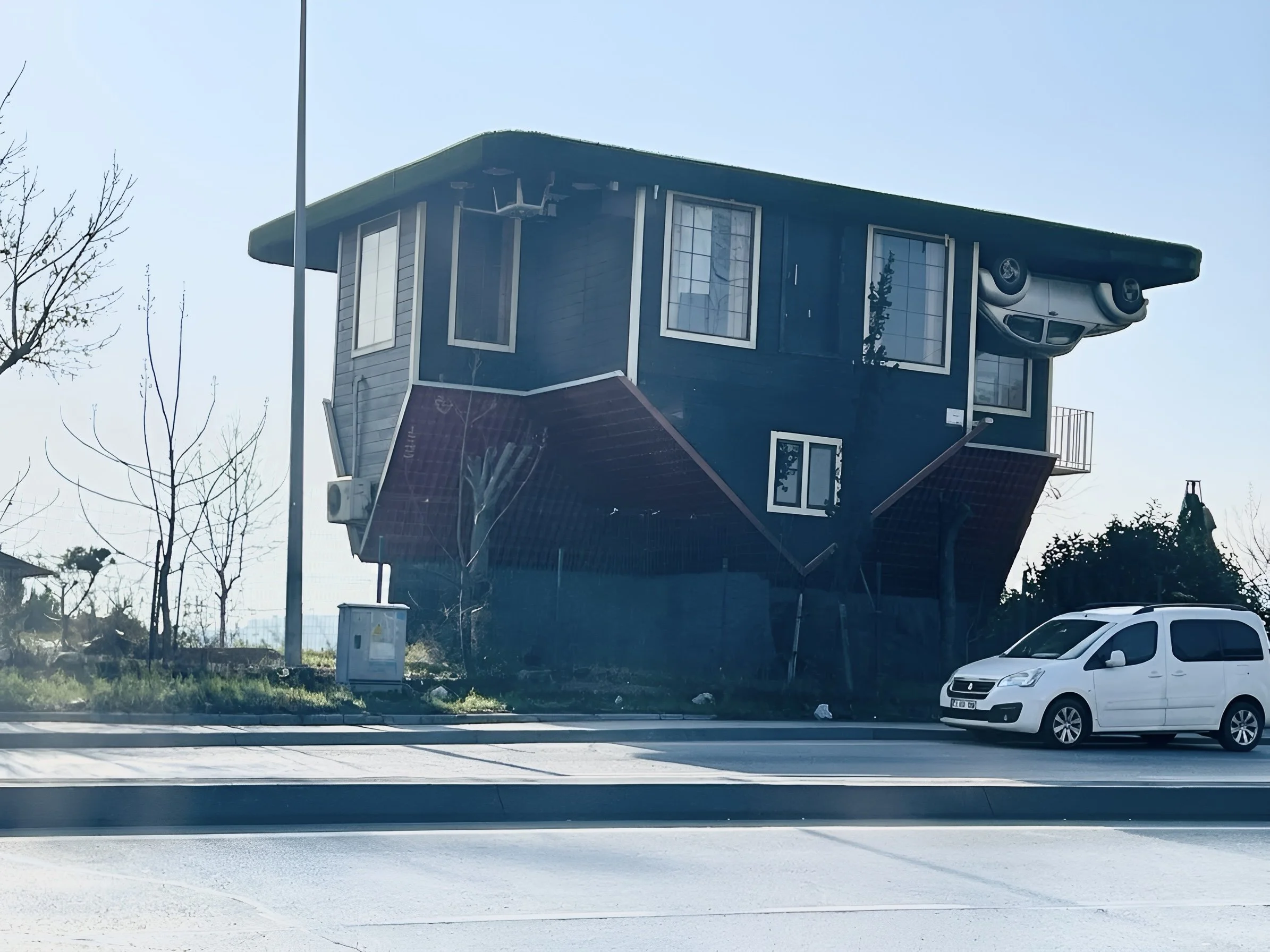
An inverted house and upside-down vehicle standing against the skyline in Beylikdüzü, Istanbul. — Photo: Alexander Pinheiro
It is something out of the ordinary and an immediate visual jolt to spot a house resting on its roof with its foundation pointed toward the sky. While an inverted building can look like an accident of nature, perhaps the aftermath of a natural disaster, the upside down element attached to it gives it a digital rendering look. These unusual structures have long attracted architectural curiosity in major cities and at tourist destinations worldwide. Even a brief glimpse from a passing vehicle can force a double-take. Suddenly seeing an inverted building while in a moving vehicle made ordinary traffic seem briefly out of place to me. In Istanbul, one of these structures can be found along the E-5 highway corridor towards Marmara Park on the city's European side. There is a striking contrast between the traffic moving normally along the asphalt and the surreal sight of an inverted roof with an attached car apparently hanging upside down.
Businessman Daniel Czapiewski built one of the best-known early modern examples in Szymbark, Poland, in 2007. The idea behind the construction was political, challenging visitors to physically navigate a disorienting interior of an upside-down home. It was intended as a statement about the disruption and instability associated with Poland’s Communist past. From there, the concept moved toward experiential tourism and commercial novelty, with similar projects appearing across Europe and eventually in other parts of the world. The rise of social media helped accelerate their popularity, giving visitors another reason to photograph themselves inside spaces where ordinary domestic surroundings seem to defy gravity.
It can be a strange physical experience stepping inside a tourist-oriented upside-down house. In some cases, the attractions are deliberately constructed with sloping floors and carefully designed visual cues that make the interior feel more disorienting. Visitors are left walking through what looks like the ceiling of an ordinary home, with furniture such as sofas and set dinner tables securely attached to surfaces that appear to be overhead. The experience has resulted in dizziness or motion sickness for some people. The combination of the tilted environment and conflicting visual signals adds a physical dimension to what begins as a visual illusion.
Although the majority of inverted structures are temporary or experiential attractions, genuine architectural inversion also exists. These are functional residential designs. However, the distinction is important. A tourist attraction may be designed and constructed for the main purpose of creating the impression that gravity has been turned upside down, with interiors specifically arranged for visitors to explore and photograph. By contrast, a real inverted home has to function as a building. For example, Dutch architect Rein Hofstra designed residential apartments in the Netherlands in the form of an inverted traditional farmhouse. From the outside, the roof points toward the ground and the walls slope inward. This creates the appearance of a house standing upside down. However, the spaces inside function as ordinary living areas, which demonstrates that an unusual exterior does not necessarily require an unusual way of living.
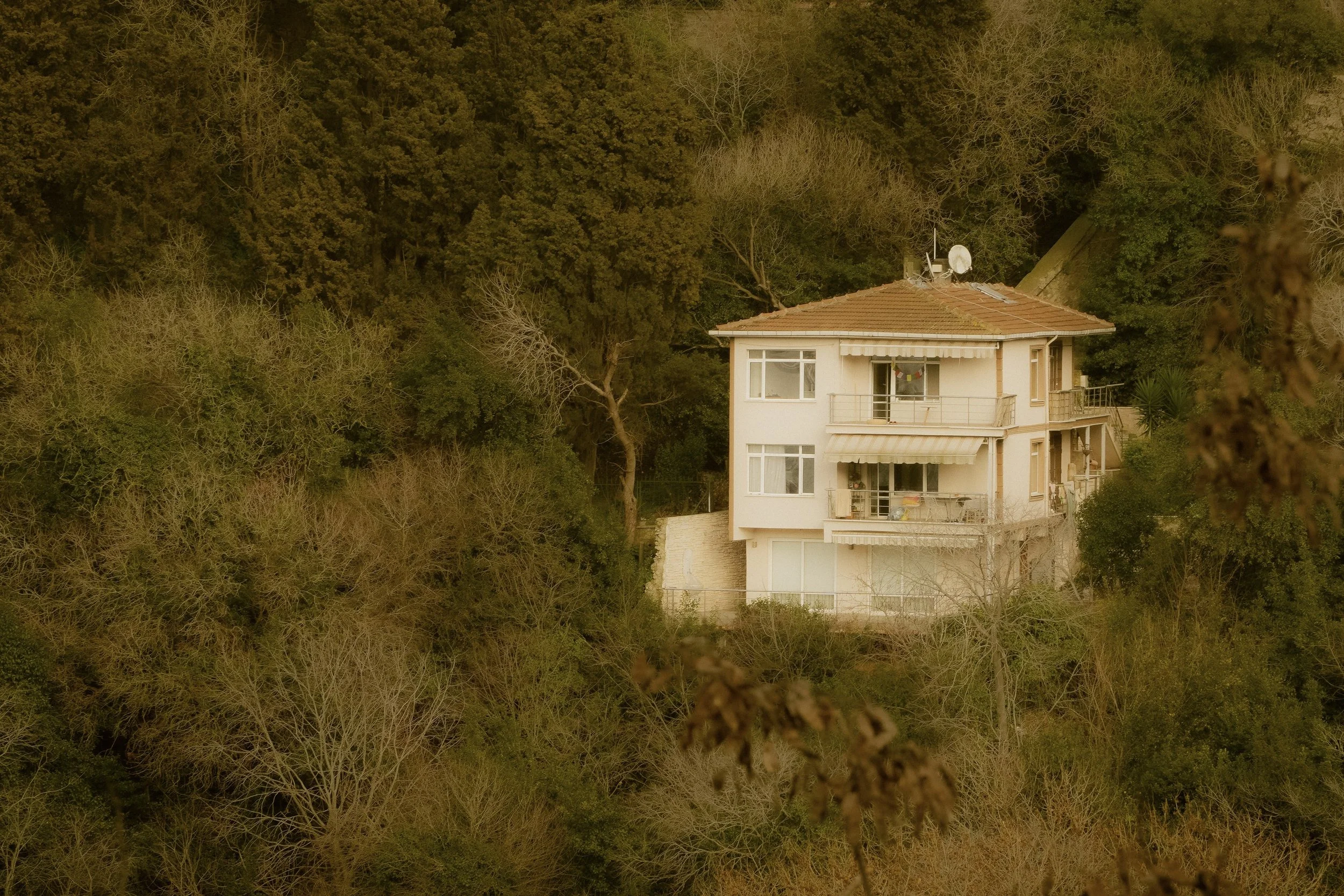
A multi-story structure built into a steep hillside in Istanbul, where the upper floors catch the sunlight while the lower levels sit in the shade.
In modern residential architecture, “upside-down living” can also describe something quite different from an inverted structure. On coastal plots, steep or ravine sites, hillside constructions, or overgrown slopes, architects sometimes reverse the traditional arrangement of a home. In these constructions, bedrooms are placed on lower floors and the main living spaces above them. The purpose of this design is not to create an optical illusion, but to take advantage of the benefits associated with elevated views or the shape of the site. In that context, the house may be considered “upside down” in relation to conventional domestic layouts while it remains completely ordinary in its structural relationship with gravity.
That distinction helps explain why upside-down houses are more interesting than they first appear. Some are political statements, some are architectural experiments, some are deliberately constructed tourist attractions, and others are simply clever responses to a particular landscape. What they all have in common, though, is the ability to disrupt an expectation that is so familiar. The reason I was jolted comes down to something we rarely think about: a house has a roof above it and a foundation below it. Reverse that relationship, and something as ordinary as a building suddenly becomes an object of immense curiosity.
Perhaps that is why these structures continue to attract attention from leisure photographers to content creators. They do not require an elaborate explanation before they make an impression. A house standing on its roof is immediately understood as something that should not be there, even when everything about it has been carefully engineered. For whatever reasons they are built, these abnormal buildings demonstrate that sometimes all it takes to shift perspective is turning a house on its roof.
Written by: Alexander Pinheiro
© 2026 Sane House Media
These articles are published for general information, commentary, cultural interest, and entertainment. They may contain personal observations, opinions, interpretations, or information from third-party sources. While every effort is made to ensure accuracy, no article should be considered a definitive or comprehensive account. Some, all, or none of these conditions may apply to this particular article.
