In Defense of the Economy Tray
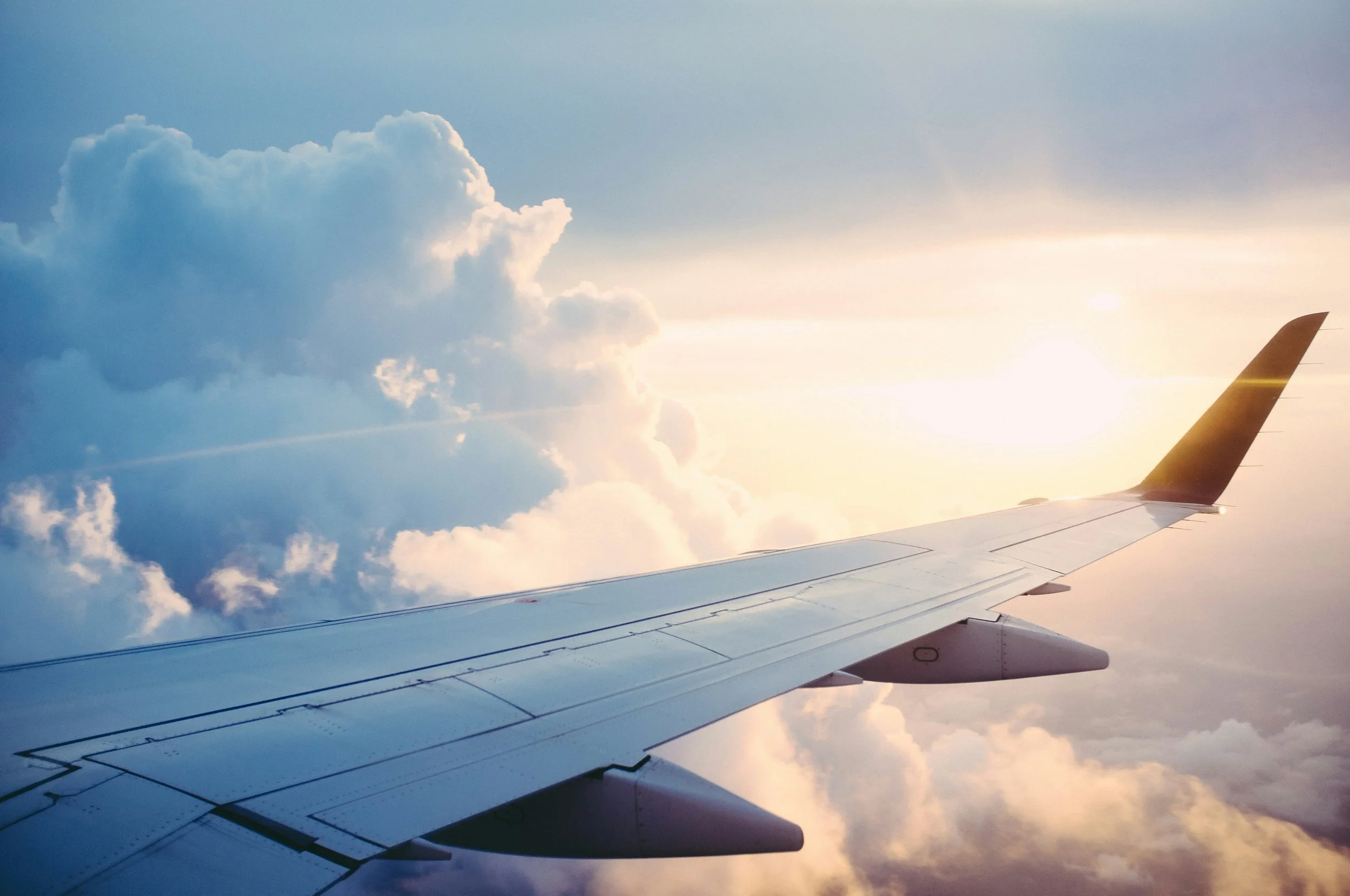
Cruising high above the clouds under the brilliant glow of the afternoon sun.
Ask ten travelers about economy-class airplane food, and nine will launch into a familiar routine. They will tell you about soggy vegetables and meals that taste like unseasoned cardboard. For decades, the in-flight tray has served as a universal punchline of travel culture. It is continuously viewed as a necessity endured mainly because there is little else to eat at 35,000 feet.
However, I absolutely love airplane food, and whether it is served in economy class or another cabin makes little difference to me. But it’s the humble economy tray that so many people love to hate that holds a special place in my travel routine. In fact, when I am not in a hurry to reach my destination, I have sometimes chosen a flight with a layover because it gives me the opportunity to see another city along the way and, as a bonus, enjoy a second meal service. My son shares the same peculiar enthusiasm. We have developed our own little ritual around it, including the occasional exchange of food when one of us decides that the other person’s choice looks better.
I remember one flight particularly well. He had chosen beef, while I had chosen chicken. We opened our trays, looked at our respective meals, and he immediately decided that he wanted the chicken. So I gave him mine and took the beef. This is the sort of thing that probably sounds ridiculous when described outside the context of an airplane, but when you are sitting beside each other at cruising altitude, comparing two small trays of food, it feels perfectly natural.
Part of what makes the experience fascinating is the elaborate system behind that seemingly modest tray. Long before the meal reaches the passenger, it has passed through an industrial catering operation designed to produce thousands of meals efficiently and consistently. Airline meals are generally prepared, portioned, cooled, assembled, transported to the airport, and loaded onto the aircraft, where they are reheated before being served. It is a very different process from preparing food at home or in a restaurant, and the meals have to be designed with that journey in mind.
That is one reason dishes with moisture and robust flavors tend to work particularly well in the air. Sauces, stews, curries, braised meats and other dishes that retain moisture can withstand the chilling and reheating process better than foods that depend on crispness or delicate textures. The cabin environment presents another challenge. At cruising altitude, the air is extremely dry and the cabin pressure is lower than at sea level. These are conditions that can diminish our perception of certain flavors and aromas. Research into the effects of simulated aircraft conditions has found that sweetness and saltiness, in particular, can become less noticeable in the air. The food therefore has to survive not only the catering process but also the peculiar sensory environment in which it is finally eaten.
When the cart rolls down the aisle, all of that engineering is reduced to something wonderfully simple: a tray of food placed in front of you. The main dish sits beneath its foil cover, accompanied by a miniature bread roll, a small portion of butter, perhaps a salad, a dessert and a drink. Everything is arranged to fit into a space barely large enough to accommodate it, and there is something deeply satisfying about the compactness of it all. I enjoy the ritual of opening the tray and discovering what is inside, even when I already know what the menu is supposed to contain.
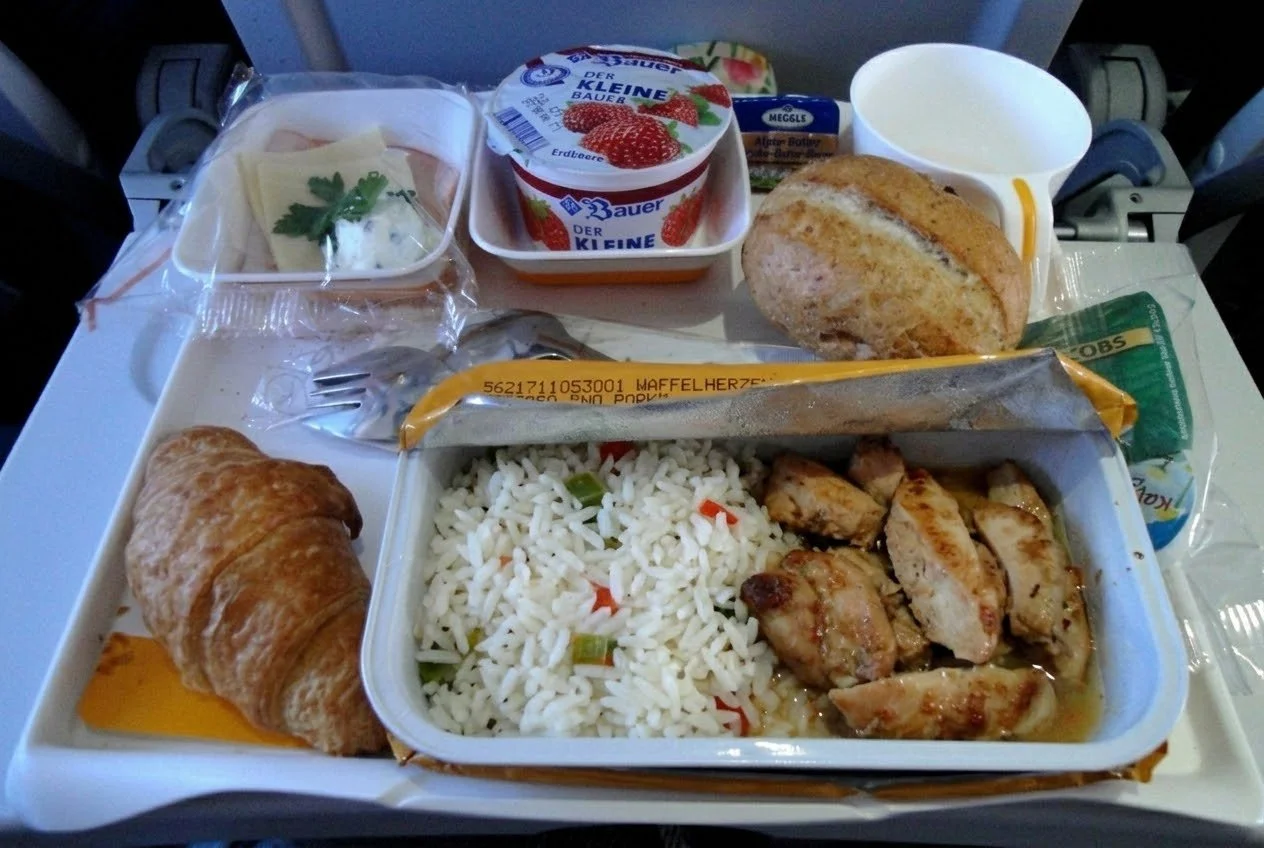
Chicken, rice, and a surprising amount of sides: a complete, full-service economy meal.
Of course, there is nothing particularly luxurious about the experience of eating in economy class. Your elbows may compete for space with the passenger beside you, while the tray table seems to have been designed according to a mathematical formula that allows precisely enough room for the meal and almost nothing else. Trying to cut food with the tiny plastic utensils, if you’re on a flight that prohibits silverware, can become an exercise in negotiation. A task made even more acrobatic when the person in front has reclined their seat. You eat in a cramped space, surrounded by the sounds and movements of hundreds of other people, and once the meal is finished, the empty containers do not magically disappear. They remain on the tray or in front of you until the cabin crew comes back to collect them.
Yet even these inconveniences have become part of the ritual for me. The cramped tray table, the plastic utensils, the struggle to fit everything into place, and the wait for the cart to return are all part of the packaged deal. I am not mistaking economy class for luxury, but there is a distinct psychological pleasure in being served a meal while traveling. In ordinary life, eating requires effort. You have to decide what you want, shop for it, prepare it, or, on the other hand, order it or go to a restaurant and pay for it. On an airplane, many of those steps disappear. You sit in your seat, someone comes down the aisle, and a meal simply arrives in front of you. You eat it, and although the empty tray may sit there for a while afterward, at least there are no dishes to wash.
Perhaps that is why I enjoy the airplane meal so much despite everything people say about it. I am not suggesting that it rivals every great meal to be found on the ground. Far from it. There is extraordinary food to be found in restaurants, markets and kitchens everywhere, and some of the best meals are the ones prepared slowly and lovingly at home. You can take that to the bank, from a guy who likes to cook. What I enjoy about the airplane meal is something different: the combination of food, ritual and circumstance. It is a familiar human experience placed in an unfamiliar setting.
A meal eaten at home can be perfectly good and still remain part of the ordinary rhythm of the day. A meal eaten on an airplane carries the feeling of departure, It tells you that you are already on your way somewhere and that the routines on the ground have temporarily been suspended. It also tells you that whatever is waiting at the other end of the flight is getting closer with every bite.
This is especially true when I look out the window while eating. Somewhere below me is a landscape I may never explore, while in front of me is a small tray containing rice, chicken, vegetables, bread and dessert. None of it would necessarily be remarkable under different circumstances. Yet at cruising altitude, it becomes part of the journey itself.
That, perhaps, is the real appeal of economy-class airplane food. I am not claiming that every airline has somehow discovered a secret culinary formula. Much of it is ordinary food prepared under extraordinary logistical constraints. But food does not exist independently of the circumstances in which we eat it. Context matters, and for me, eating a meal on an airplane is simply one of those experiences I genuinely enjoy, whether it is in economy class or another cabin.
While the general consensus will probably always lean toward complaining, there is a quiet community of us who genuinely look forward to the rattle of the meal cart. Call it strange, call it bad taste, or call it a secret superpower. Some of us simply know how to enjoy a meal at 35,000 feet.
Written by: Alexander Pinheiro
© 2026 Sane House Media
These articles are published for general information, commentary, cultural interest, and entertainment. They may contain personal observations, opinions, interpretations, or information from third-party sources. While every effort is made to ensure accuracy, no article should be considered a definitive or comprehensive account. Some, all, or none of these conditions may apply to this particular article.
